
Introduction and Welcome
Distinguished guests,
Esteemed policymakers, captains of industry, development partners, colleagues, ladies and gentlemen,
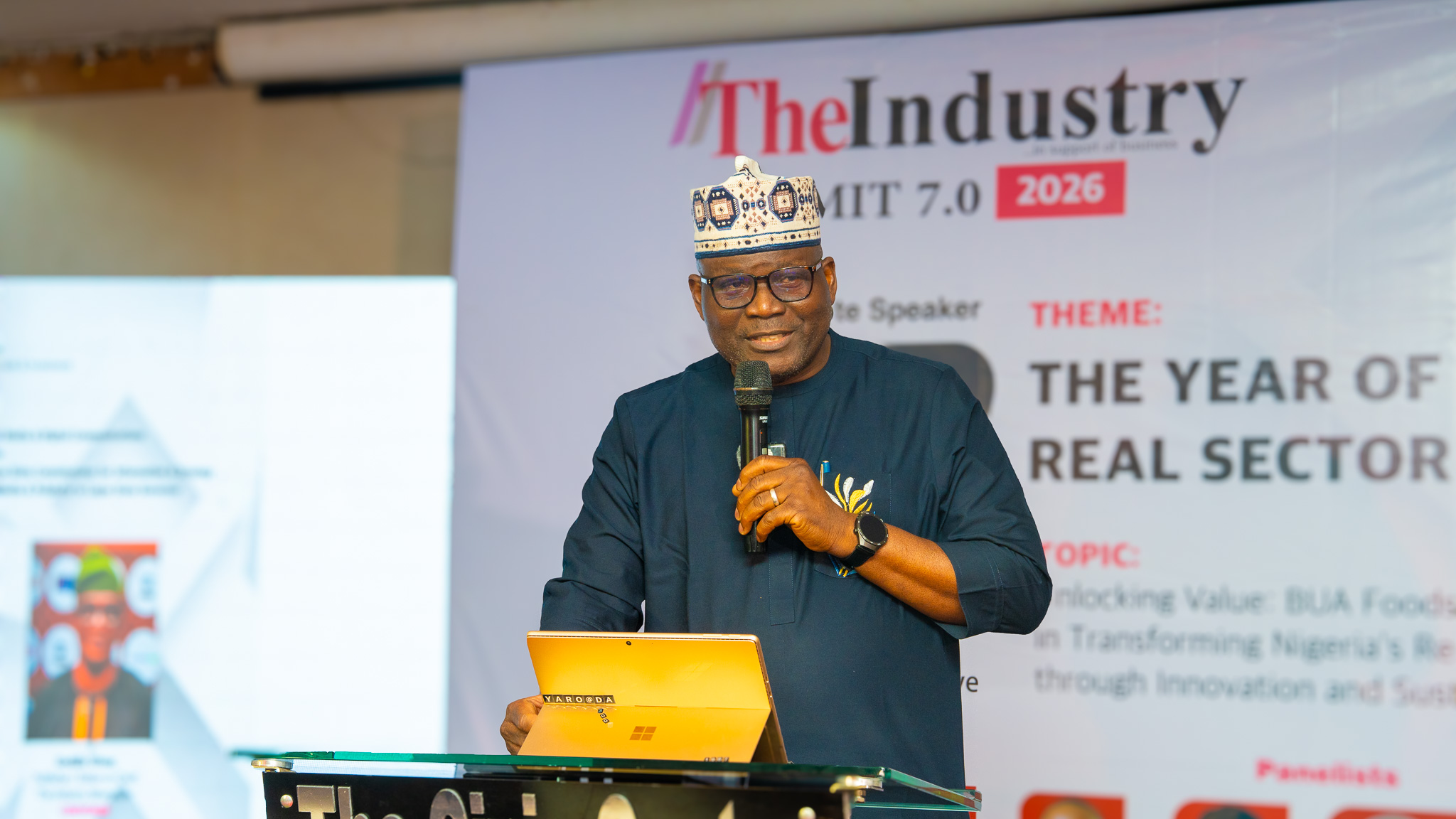
It is a great honour and privilege to stand before you today to deliver this keynote address on a subject that is not only timely, but fundamental to Nigeria’s economic future: The Theme,
“Unlocking Value: BUA Foods’ Role in Transforming Nigeria’s Real Sector through Innovation and Sustainability.”
I warmly welcome you to this important gathering of leaders, practitioners, regulators, investors, and changemakers who share a common commitment to Nigeria’s growth and prosperity. Today’s conversation transcends corporate performance. It speaks directly to nation-building, economic resilience, food security, industrial competitiveness, and sustainable development.
Nigeria finds itself at a defining moment. Global economic uncertainty, supply chain disruptions, climate pressures, and rapid demographic growth demand responses that are deliberate, innovative, and inclusive.
At the centre of this response lies the transformation of the real sector—the engine that converts human effort, natural resources, and capital into tangible economic value.
As a major participant in Nigeria’s food and agro-allied manufacturing ecosystem, BUA Foods firmly believes that the private sector has both a responsibility and an opportunity to lead this transformation.
Today, I will share insights from our experience on how innovation, sustainability, and strategic partnerships can unlock enduring value across Nigeria’s real sector. Let begin with…
Understanding the Real Sector and Its Economic Role
Ladies and gentlemen,
The real sector comprises the segments of the economy that produce tangible goods and essential services. It includes agriculture, manufacturing, processing, construction, mining, and logistics—sectors that transform raw materials into food, consumer goods, infrastructure, and industrial outputs that support daily life.
Unlike speculative or purely financial activities, the real sector:
- Creates physical and productive assets
- Generates large-scale employment
- Strengthens domestic supply chains and
- Anchors economic self-reliance
In emerging economies such as Nigeria, the real sector offers the strongest pathway to:
- Job creation, particularly for youth and semi-skilled labour
- Import substitution and foreign exchange conservation
- Food and industrial security
- Broad-based inclusion
- Technology transfer and skills development
Agriculture and agro-processing alone account for a significant share of Nigeria’s employment and GDP. Yet, their potential remains under-realised due to structural challenges including infrastructure deficits, inconsistent policies, limited access to long-term capital, low productivity, and weak value-chain integration.
To unlock the real sector’s full value, Nigeria must move decisively beyond primary production toward local processing, scale, efficiency, and industrial competitiveness. This transition is not optional, it is essential.
Recent Performance of Nigeria’s Real Sector
Distinguished guests,
Recent economic data underscores the growing importance of the real sector.
According to the National Bureau of Statistics, Nigeria’s economy grew by 4.07% year-on-year in Q4 2025, with full-year growth of 3.87%, marking a clear improvement over 2024 performance. Notably, this growth was driven largely by non-oil, real-sector activities, reinforcing the sector’s centrality to national output.
- Agriculture contributed approximately 25.67% of nominal GDP in Q4 2025 and grew by about 4.0% in real terms, supported primarily by crop production despite security challenges, climate risks, and rising input costs.
- Manufacturing, a cornerstone of value addition and industrialisation, recorded modest but positive momentum, with real GDP growth of approximately 1.1% in Q4 2025 and nominal output of ₦4.73 trillion, reflecting gradual recovery amid energy, logistics, and forex constraints.
- Collectively, agriculture, manufacturing, construction, and mining account for the bulk of Nigeria’s employment and domestic production.
These figures affirm a simple truth: sustainable economic growth must be anchored in productivity and value creation—not consumption alone.
Impact of Government Reforms on the Real Sector
Nigeria’s non-oil real sector now accounts for over 96% of total GDP, underscoring the economy’s steady decoupling from crude oil dependence.
Recent government reforms focused on:
- Agricultural self-sufficiency
- Infrastructure development
- Local production incentives
- Trade facilitation and industrial policy
- Macroeconomic stabilisation
are beginning to yield positive outcomes.
Agriculture expanded by approximately 4.0% year-on-year in Q4 2025, while industry—including manufacturing, construction, and mining—recorded growth of about 3.9%, reflecting early benefits of infrastructure spending and private capital deployment.
However, productivity remains Nigeria’s biggest challenge. While the real sector employs millions, output per worker remains low relative to peer economies. This gap highlights the urgent need for technology adoption, scale, energy efficiency, and deeper value-chain integration.
Recent tariff reforms aligned with the African Continental Free Trade Area (AfCFTA) framework—particularly the newly approved 2026 fiscal measures—present a critical opportunity. Yet, implementation must be swift and deliberate. For example, Nigeria’s annual sugar demand of approximately 1.8 million tonnes underscores the urgency of expanding domestic capacity to meet national needs sustainably.
BUA Foods’ Role in Transforming the Real Sector
Ladies and gentlemen,
At BUA Foods, our journey is guided by a clear philosophy:
Nigeria must produce what it consumes—and produce it efficiently, competitively, and sustainably.
In the words of our Founder and Chairman, Alhaji Abdulsamad Rabiu, CFR, CON:
“We must produce what we eat and add value through our people and our economy.”
Our contribution to real-sector transformation is anchored on four strategic pillars:
- Backward Integration and Value-Chain Development
We are investing extensively in large-scale agriculture, milling, processing, storage, and logistics to reduce import dependence and strengthen local supply chains.
Through our structured community partnership in agriculture schemes, farmer education, and guaranteed off-take arrangements, we integrate thousands of smallholder farmers into formal value chains—improving productivity, stabilising incomes, and promoting rural development.
- Industrial Scale Investment and Efficiency
Ladies and gentlemen,
We continue to invest deliberately in our manufacturing platforms—investments that emphasize modern technology, energy efficiency, and economies of scale. Why? Because we believe Nigerian-made products must not only meet local demand but also compete confidently on regional and global stages.
At the same time, we are playing our part in addressing Nigeria’s food supply challenges. Over the last few years, we have increased capacity by more than 40 percent across our business divisions. And we are not stopping there. In the coming years, we are committed to delivering an additional 55 percent capacity expansion—ensuring greater availability, resilience, and long-term food security for our country.
- Sustainability and Responsible Operations
We embed sustainability across our operations through resource efficiency, waste reduction, environmental stewardship, and community engagement—ensuring long-term value creation beyond financial returns.
In addition, we are committed to strong sustainability governance and transparent reporting in line with the IFRS Sustainability Disclosure Standards. Guided by the Financial Reporting Council of Nigeria, this commitment supports the adoption of International Sustainability Standards Board (ISSB) guidelines and reinforces the integration of sustainable practices across our operations.
- Human Capital and Institutional Partnerships
Ladies and gentlemen,
If there is one lesson history teaches us, it is this: no real sector transformation succeeds without people at its core. Technology can upgrade factories. Capital can scale operations. But it is people who sustain progress.
That belief drives everything we do at BUA Foods. We invest deeply in our people, developing skills, strengthening safety, building leadership, and retaining talent—because when people are empowered, industries are transformed.
We also know that lasting change requires partnership. That is why we work closely with regulators, research institutions, host communities, and development partners to strengthen capacity and accelerate knowledge transfer across the sector.
Our impact is clear. We have created over 3,000 new jobs, with more to come, and positively touched the livelihoods of more than 10,000 supply-chain partners across our ecosystem—advancing inclusive growth and shared prosperity.
Through these efforts, BUA Foods is doing more than producing food. We are building systems, strengthening capabilities, and renewing confidence in what Nigeria’s real sector can achieve—because when people thrive, industries endure, and nations rise.
Conclusion and Call to Action
Distinguished ladies and gentlemen,
Let me conclude with this fundamental truth:
Nigeria’s economic future will not be built in boardrooms alone or on balance sheets—it will be built in farms, factories, laboratories, warehouses, and logistics corridors across the nation.
Unlocking value in the real sector demands collective commitment:
- Government must provide a predictable and enabling policy environment
- The financial sector must support long-term productive investment
- The private sector must invest responsibly, innovate boldly, and operate sustainably
- Academia and research institutions must drive applied knowledge and local solutions
At BUA Foods, we remain resolute in our commitment to invest in Nigeria, empower Nigerians, and build enterprises that deliver value far beyond profits.
I therefore call on all stakeholders here today to renew our collective commitment to real-sector transformation. Let us collaborate, innovate, and invest with purpose—so together, we can build a productive, resilient, and inclusive economy that truly unlocks Nigeria’s immense potential.
Thank you for your kind attention.
God bless our industries.
God bless Nigeria.